
Introducing Joy-O-Meter
The human signal business has been missing
Embracing joy in the workplace is more than a feel good initiative - it’s a strategic competitive advantage.
The Joy-O-Meter is driven by a singular vision: to reveal and magnify joy in the world. We focus on the area where we can have the greatest impact – workplaces, where people spend most of their waking hours. Joyful employees are more likely to deliver exceptional customer experiences, driving customer loyalty and leading to business growth.
Joy already exists in organisations — our role is to shine a spotlight on it and help organisations elevate it into a strategic business priority. What gets measured gets prioritised. And what gets prioritised gets transformed.
Our mission: To Transform the World of Work!
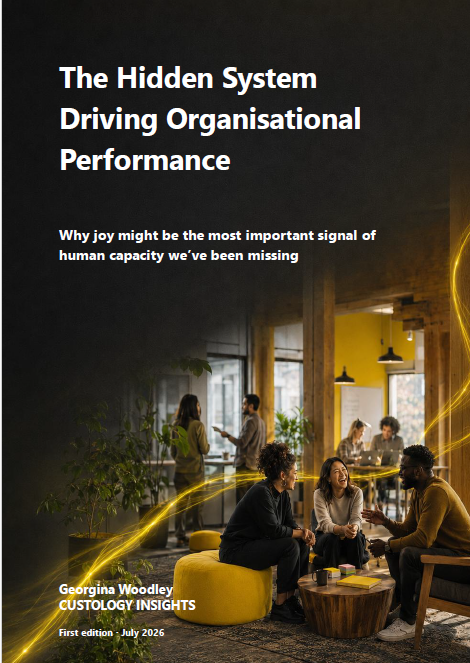
We are on a mission to get joy at place at the boardroom table. Download our whitepaper:
Check out our latest podcasts and webinars here:
How Stress and Joy Shape Customer Experience with Cassandra Welford, Podcast Guesting Pro
Why Joy at Work Matters More Than Leaders Think with Wendy Sellers, The HR Empowerment Podcast
Boosting Manufacturing Outcomes by Understanding Human Energy, with Jon Franko, The Manufacturing Employer
Introducing Human Energy Intelligence: Making the human conditions driving performance visible.
The organisational blindspot
Most organisations believe performance is driven by strategy, systems, and execution.
It’s not.
It’s driven by the human capacity of the people executing it.
Stress contracts capacity.
Joy expands it.
It’s that simple.
Perhaps that's the biggest blind spot in modern business. If strategy only performs to the level of human capacity available to execute it, then understanding what shapes that capacity may be one of the most important leadership challenges of our time.
The evidence is compelling. When people feel better, they perform better
This is not theory, it’s well researched and documented.
Happier workers +13% productivity (Oxford “Happiness and Productivity”)
High wellbeing teams +17% productivity (Gallup State of the Global Workplace meta-analysis),
Positive state +31% productivity, (Harvard Research “The Happiness Advantage”)
Think back to a time when you were completely in flow.
You were energised.
Ideas came easily.
You solved problems more creatively.
You connected effortlessly with people.
Time disappeared.
Work didn't feel like work.
You probably weren't thinking about it at the time...but chances are, you were experiencing joy.
Not happiness.
Not excitement.
Joy.
The kind of joy that comes from feeling connected to what you're doing, the people around you and the impact you're creating.
Now imagine that state wasn't something you stumbled into by accident.
Imagine leaders understood how to create more of it.
Imagine teams spent more time there.
Imagine organisations designed for it.
How much untapped capacity would be unlocked?
Because that's what I think we've been missing.
Joy has the potential to radically transform business success!
You’re already losing performance — you just can’t see where.
Most organisations are operating under hidden, accumulated stress. And stress on the inside shows up on the outside in poor customer experiences.
Here’s what happens when there’s stress in the system…
Decisions feel slower and less certain
Teams look fine on paper but underperform in reality
Customers disengage without a clear reason
Effort increases… but outcomes don’t scale
Not because the strategy is wrong.
Because the signal you’re using to guide decisions is incomplete.
Joy is one of the most powerful signals inside human systems.
But right now, that layer is largely invisible.
Where organisational stress becomes commercial cost
Stress inside a system doesn’t just sit there.
It shows up as:
Productivity leakage
Slower decisions, reduced focus, rework and hidden inefficiency
(~15–20% payroll - Gallup, Harvard Business Review)
Turnover and burnout
Capability loss, replacement costs and leadership strain
(30–200% salary per role - Society for Human Resource Management, Deloitte)
Absenteeism and mental health
Reduced workforce capacity and presenteeism
(3–5% payroll - World Health Organization)
Customer experience leakage
Inconsistent delivery, trust erosion and lost loyalty
(1–3% revenue - Forrester, Temkin Group)
Individually, these pressures may appear manageable. Together, they compound across the organisation.
For a 100-person organisation, this can quietly equate to $3M–$5M+ per year in direct costs and lost performance!
Most organisations are already paying for this. They just can’t see the full signal clearly enough yet.
And the most dangerous part is that it happens quietly — before it shows up in your metrics.
The real issue isn’t performance, it’s incomplete visibility.
Most organisations are measuring outcomes while remaining blind to the human forces creating them.
Most organisations already have data.
Lots of it.
CX dashboards
engagement surveys
operational metrics
But all of it is: lagging, fragmented, and incomplete
It tells you:
what happened
But not:
why it’s happening
what’s driving it
what to fix first
As a result they rarely see the emotional patterns shaping those results underneath.
That gap is expensive.
Your biggest CX problem, isn’t in your CX dashboard.
So leadership teams end up making high-stakes decisions based on distorted signals.
What’s missing isn’t more data. It’s visibility of the human system driving performance.
How your team actually feels
How that shapes behaviour
How that translates into customer experience
How your customers are experiencing you
What customers bring to the exchange
And where friction is building before it becomes a problem
Every customer experience begins long before a customer interaction takes place. Customers ultimately experience the cumulative effect of thousands of human decisions made throughout the organisation.
Customer experience is organisational capacity made visible.
It’s time for joy to take its place at the boardroom table. And the starting point is measurement.
What Joy-O-Meter really is
Joy-O-Meter is not just a survey.
Joy-O-Meter is a Human Energy Intelligence system.
One that reveals the human signal behind your business outcomes.
One that helps organisations understand the relationship between human state, emotional energy, and performance.
It captures:
Staff experience
Customer experience
The underlying emotional state influencing both
So instead of guessing…
You can see:
Where your organisation is losing energy
Where performance is being constrained
Where customer experience is breaking down
What’s driving behaviour across your system
What most systems miss
Most systems:
View staff and customer experience as two systems not one
Focus on outcomes, not emotional causality
Rely on lagging indicators
Overlook the accumulated emotional memory shaping behaviour
Ignore the internal human state driving the experience of the brand
Joy-O-Meter changes that.
It:
Connects staff and customer experience – one system not two
Reveals the patterns of how internal human state impacts brand performance
Identifies hidden friction
Surfaces early warning signals
Shows what actually needs attention
What this unlocks
Joy-O-Meter makes the human cost of stress visible early — so you can reduce it before it shows up as lost people, performance, and profit.
1. Instead of reacting late…You can act early.
2. Instead of guessing priorities…You know what will move the needle.
3. Instead of pushing performance…You remove what’s constraining it.
The result:
Faster, clearer decision-making
Stronger alignment across teams
More consistent customer experience
Sustainable performance — not forced output
Why this matters now
The organisations that learn to measure human dynamics more intelligently will outperform the ones still relying purely on lagging indicators.
Because human energy is not a soft concept.
It is one of the most influential forces inside modern organisations.
Every organisation already has an emotional operating system.
Most simply don’t have visibility of it.
From insight to action
Joy-O-Meter does not claim to solve every organisational challenge.
What it does is reveal where change will matter most. That clarity changes everything.
Because once organisations can clearly see:
what’s driving behaviour
where hidden friction exists
where emotional energy is contracting
where trust and momentum are expanding
and how human state is shaping operational outcomes
better decisions become possible earlier.
And earlier intervention changes trajectories.
Our value goes well beyond the data, it’s the wisdom we bring in interpreting the patterns within it.
This is where insight becomes action and action drives transformation.
The strategic edge – from insight to organisational transformation
Joy-O-Meter reveals the signal and the consulting layer helps organisations act on it.
We are curating a range of strategic partnerships with organisations who:
Care about human performance and organisational impact
Want access to better signals and clearer insight
Are ready to be part of a new approach
Together we create a system where:
Measurement reveals the organisational challenges
Partners help implement meaningful change
Measurement validates the impact
This creates a powerful cycle of evidence-based transformation
There is no universal solution for increasing joy in an organisation, every organisation has a unique set of conditions.
Joy-O-Meter transforms measurement from reporting into organisational optimisation.
No pressure - just the option to move further and faster.
Transformation should be measurable
We work with organisations to integrate their own business metrics alongside Joy-O-Meter insights so meaningful correlations can be observed over time.
This creates visibility into how shifts in human state influence:
retention
productivity
collaboration
customer experience
leadership effectiveness
burnout risk
decision velocity
and organisational resilience
Not theoretically. Operationally.
Because if transformation is real, it should move the numbers.
How it works
Simple to implement. Designed for strategic clarity.
Joy-O-Meter includes:
5-10 minute short-form human signal surveys
Workforce and customer participation options
Low time investment for teams
Flexible delivery cadence
Email or QR code distribution
Scalable organisational deployment
Longitudinal pattern tracking
Insight interpretation and analysis
Participation is intentionally lightweight. But the signal it reveals is not.
The result is a clearer understanding of:
where friction exists
where momentum is growing
where attention is needed
and where transformation is already unfolding beneath the surface.
See what’s really driving your organisation’s performance
The invisible dynamics inside your organisation are already influencing results. Because beneath every business outcome is the human experience that’s shaping it.
Joy-O-Meter simply makes that system visible and actionable.
So you can stop relying on incomplete data and making decisions based on incomplete signals, and start making decisions based on what’s actually driving your business.
If that sounds interesting, let’s take a closer look.